Everyone is using ChatGPT. Barely anyone knows what’s actually happening when they type something and hit enter. I didn’t either until this class broke it down and honestly it made me think about it completely differently.
It’s not looking just things up or searching a database. It’s doing something much stranger than that.
It starts with prediction.
At its core a large language model like ChatGPT is a next word predictor. It was trained on an enormous amount of text from the internet, books, articles, code, conversations, and it learned the statistical relationships between words. When you type a prompt it calculates what word is most likely to come next, then what word comes after that, and keeps going until it produces a complete response.
Such a weird thing to think about! Something that can hold a conversation and write code and summarize documents is, at its foundation, just really good at guessing the next word.
Neural networks and gradient descent.
ChatGPT is built on a neural network with billions of parameters. Think of parameters as dials. During training the network made predictions, checked whether they were right, measured how wrong it was, and then adjusted all those dials slightly in the direction that reduced the error. That process is called gradient descent.
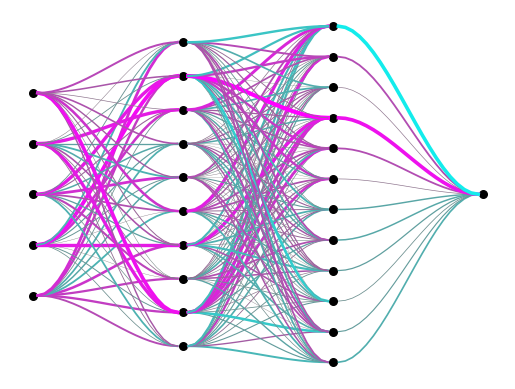
Backpropagation is how the error signal travels back through the network to figure out which dials need adjusting and by how much. Do this billions of times across hundreds of billions of words of text and something remarkable happens. The network doesn’t just learn to predict words. It develops internal representations of concepts, facts, relationships, even something that looks like reasoning. Nobody fully understands why. That’s the emergent property from the last post showing up again.
What it can’t do.
Here’s where it gets important especially if you’re thinking about using AI in a business context.
ChatGPT has no memory between conversations unless you give it one. It has no access to real time information unless it’s connected to a search tool. It doesn’t know what it doesn’t know. It will confidently produce wrong answers because it’s optimizing for what sounds right based on patterns, not for what is actually true. I have experienced this repeatedly.
Professor Cutting pointed this out directly on the syllabus. ChatGPT does a truly terrible job explaining the advantages and limitations of digital representation because it has no idea what was discussed in class. It can only pattern match to things it was trained on.

This is a very useful thing to understand. The tool is powerful but it has a specific kind of blindness baked into how it works.
The copyright issues are wild.
One thing that came up in class that I keep thinking about is the idea that every possible melody has already been copyrighted and released into the public domain. The logic is that melodies are just combinations of notes and there are only so many of them. A programmer mathematically generated all possible short melodies and copyrighted them specifically to prevent anyone from being able to claim ownership over a melody in the future.
ChatGPT trained on essentially all human generated text creates a similar question. If it learned to write by reading everything humans have written, who owns what it produces? That question is very much unsettled legally right now and it’s going to matter enormously to anyone building a business on top of these tools.
Why this matters for entrepreneurs.
The businesses being built on top of large language models right now are mostly wrapping a thin product layer around someone else’s model. That works for now but it’s not a strong position long term. The more interesting question is figuring out where AI actually produces reliable outputs and building real workflows around those specific things instead of just assuming it’ll figure everything out. The entrepreneurs who understand the limitations of the tool are going to make better decisions with it than the ones who just trust the output.
Grammar checked with Claude (claude-sonnet-4-6, Anthropic, May 2026, claude.ai/chat). Prompt: “Please check the following blog post for any grammar, spelling, and punctuation errors. Do not change the meaning, tone, or structure of the writing. Only fix errors.”
Sources
https://www.youtube.com/watch?v=Ilg3gGewQ5U
https://www.youtube.com/watch?v=uCIa6V4uF84
https://www.youtube.com/watch?v=IHZwWFHWa-w
Leave a Reply